Buy 2 Get Free Delivery
About
Fountain Pens
As far back as 2000 BC, Egyptians invented something that changed the world forever. This invention made it possible for humans to create, share and learn and to retain and communicate knowledge, information and works of art down through the generations.
Yes, we are talking about the humble pen. From reed pens, quill pens, stylus and steel-point pens, man graduated to fountain pens, ball pens, roller-ball, get-tip pens and gel pens. Out of these, some were forgotten and are obsolete, some are used by the masses, but the fountain pen is the one that stands out! A man who hasn’t written with a fountain pen, knows not the joy of writing!
The inconvenience of having to keep dipping a pen to replenish its ink supply, as in quill pens, Reed pens and steel-point pens, fuelled the creation of the fountain pen, which holds ink in a reservoir and passes it through to the nib.
It was first Petrache Poenaru, a Romanian inventor, who received a patent for the invention of the very first fountain pen with an ink barrel in 1827. In 1884, Lewis Edson Waterman developed and gained a patent for the three-channel ink feed fountain pen. This improved design ensured a smooth flow of ink during writing, and revolutionised the pen into a portable tool.
Why use a fountain pen when we can use cheap and convenient ball pens, you will ask! Let me tell you:
Ballpoint pens use oil-based inks that need pressure to flow, while a fountain pen writes just by the force of the pen's weight on the paper. The hand merely guides the pen along. This significantly reduces hand fatigue by eliminating the "death grip" that ballpoint users tend to use while writing. One of the aesthetics of fountain pen writing is the varying line widths achieved by changing the writing pressure, and these variations in width and ink shade could turn a handwritten page into a thing of beauty. A fountain pen is a friend for life, you needn’t ever throw it away! Imagine the amount of plastic that goes into landfills everyday due to disposed ball pens. We can opt to go completely eco-friendly with a fountain pen! Most fountain pens are thick and have nice, comfortable grip sections, making writing a stress-free business. One can avoid hand fatigue and carpal tunnel syndrome if using a fountain pen, since right kind combination of nib and ink can help the pen glide over a sheet of paper, with minimum friction between the two. A fountain pen is a treasure, like a piece of precious jewellery. Starting from cheap ones that cost a few dollars to ones that can cost a million, there is something out there for everyone. Wooden, metal, plastic, ebonite, glass, gold-nibbed, diamond-encrusted; you name it and will have it! Today, on fountain pen day, let’s pay an ode to the King of writing instruments, the fountain pen...

Anatomy of a Fountain Pen
There are a lot of parts and pieces to a fountain pen, and sometimes it's confusing which parts are called what, especially if you're newer to the hobby. Depending on who you're talking to, there are different names for different parts, and it can be tough to try to troubleshoot when you're calling parts different things to someone else! We've noticed this when trying to help our customers by phone or email, so we put together this infographic to show some of the most commonly talked-about pen parts.
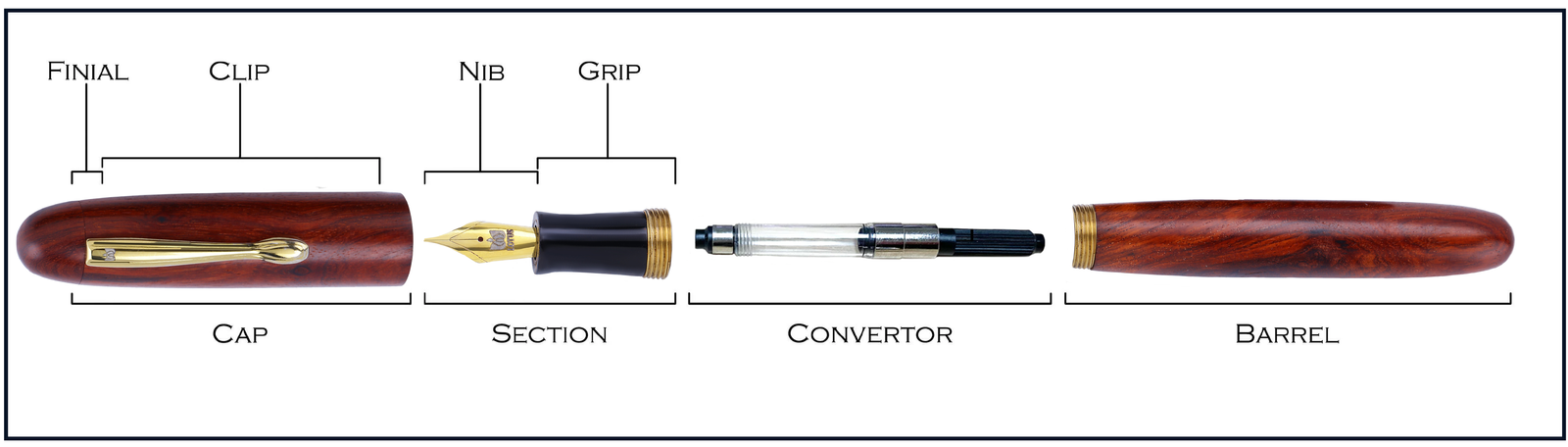
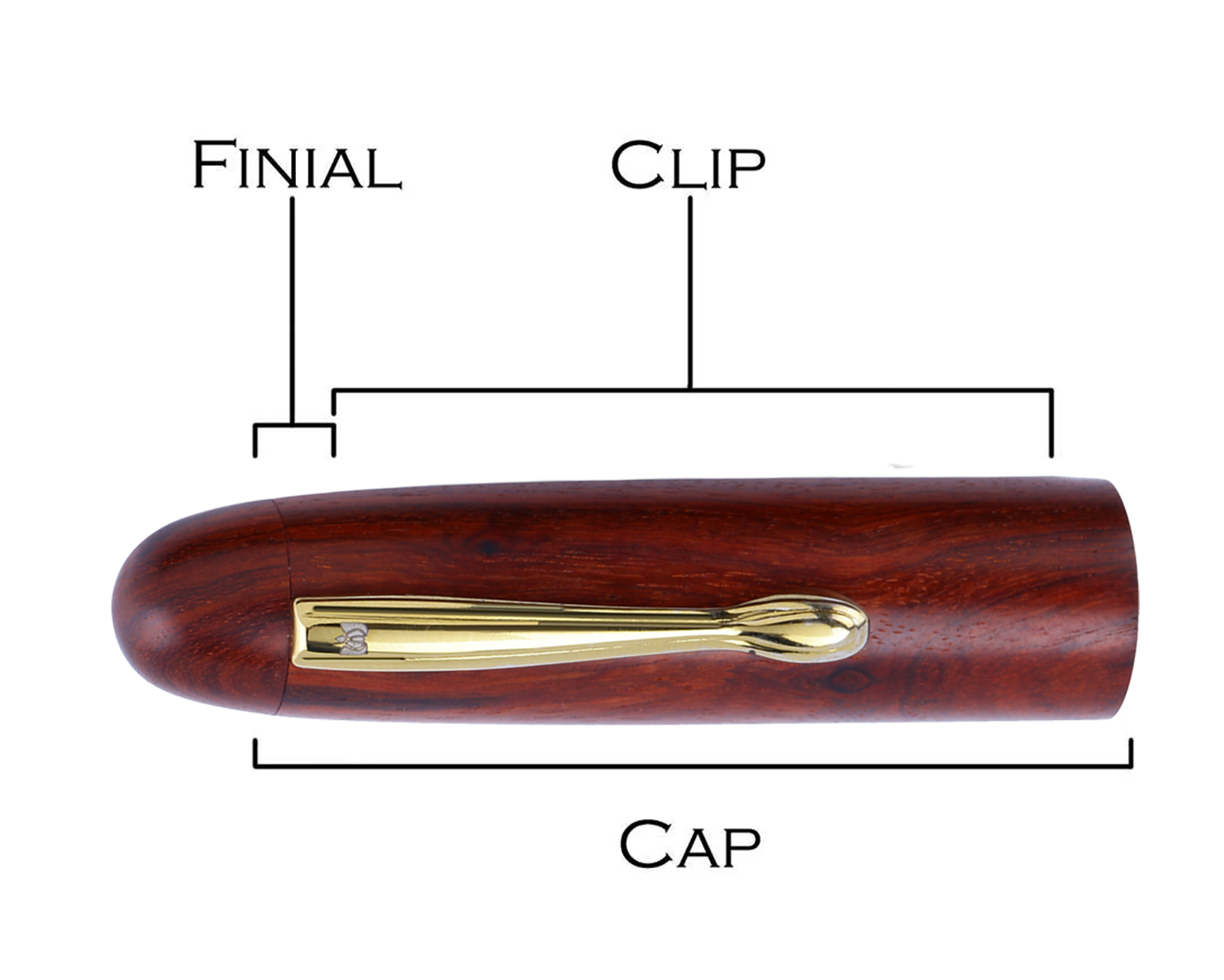
Cap: the part of a pen that covers the nib and attaches to the pen body. Clip: the metal doohickey usually attached to the cap that holds your pen in your shirt pocket and also keeps it from rolling off your desk and landing nib first on the ground (why does it ALWAYS fall nib down??) Finial: the top of the cap, sometimes decorated with the maker's logo. Insert: the plastic liner on the inside of some pen caps that help seal the nib and keep it wet when capped. Centerband: the metal decorative ring that is usually placed near the bottom of the pen cap for decorative purposes, or perhaps to provide reinforcement to the cap threads. Lip: the open end of the cap, where the threads of the body fit to close the pen.
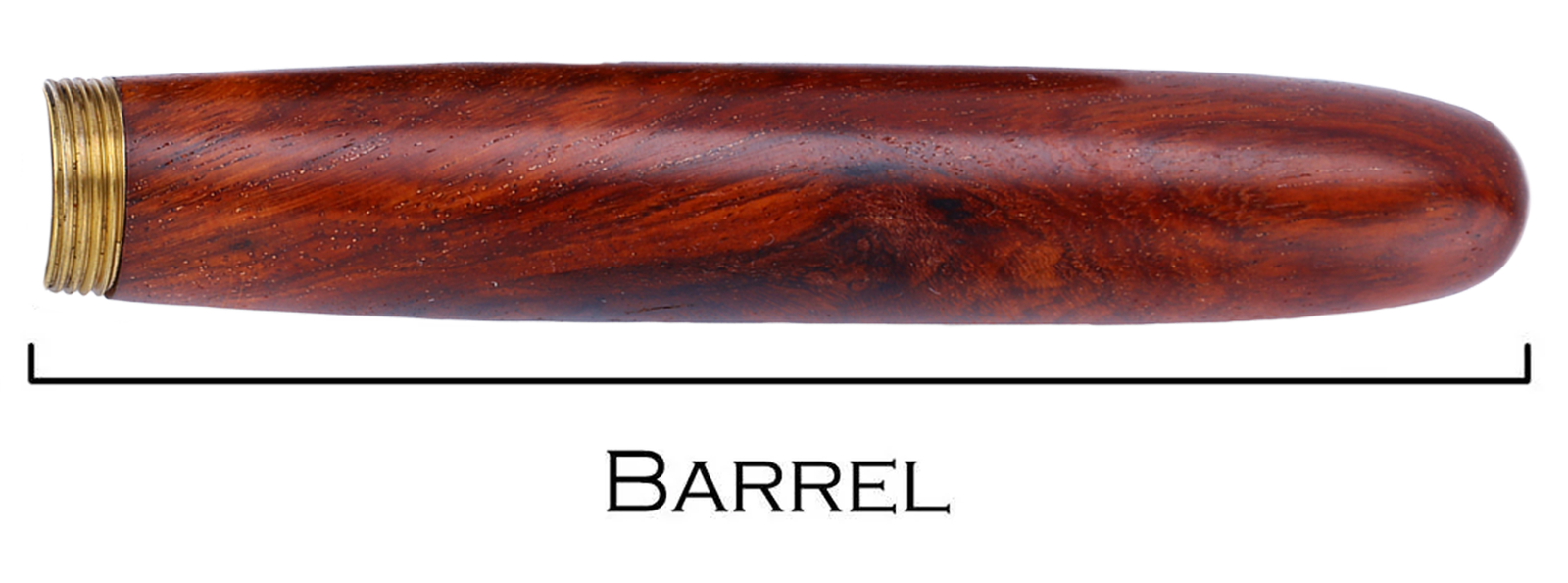
Barrel: the long part of the main body of the pen which houses the ink reservoir. Threads: thin grooves cut into a pen to hold parts together, especially pen caps to the pen body. Step: the part of the barrel where the threads 'step up' to the body, which can matter when holding the pen. Body: the length of a pen barrel that typically houses the ink reservoir. Trim Ring: ornamental accents that serve an aesthetic purpose.
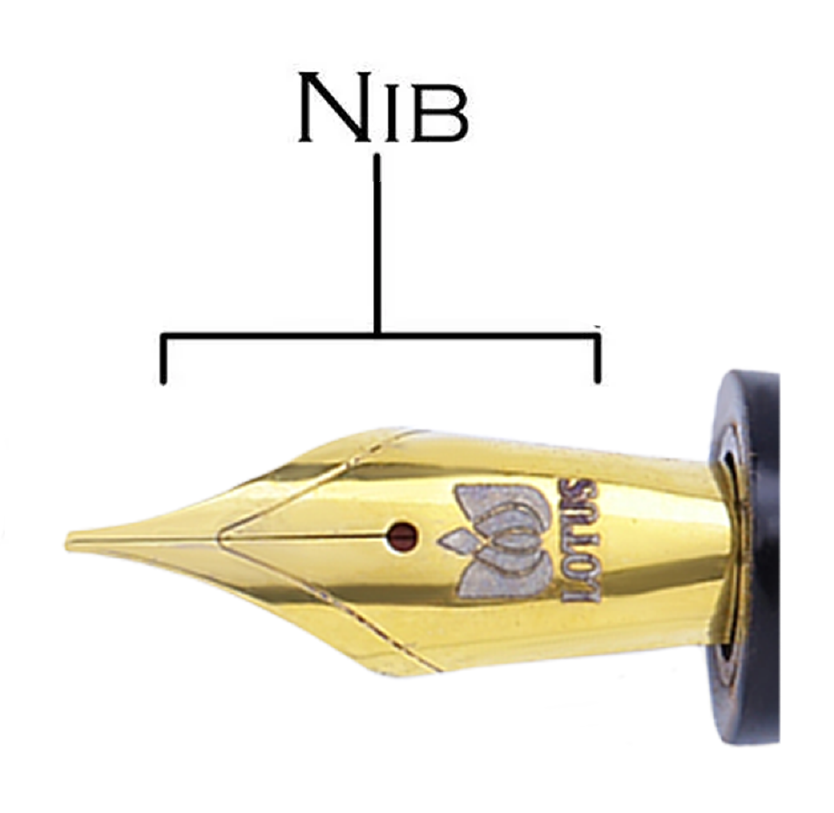
Nib: the metal tip of a fountain pen that actually touches the paper. Tipping Material: a small bit of hard-wearing metal (usually some sort of iridium alloy) that is welded to the end of a nib and ground to a specific intended size. Slit: the very thin cut running from the breather hole to the tip of the nib that carries the ink from the feed to the tip. Tines: the two front parts of the nib that taper to the tip. Shoulder: the widest part of a nib, where it starts to taper towards the tip. Breather Hole: a hole in the nib, at the end of the nib slit, that allows air to assist in the ink flow, also called a vent hole. Imprint: the engraving or impression left on the face of the nib that shows the brand, model, or nib size. Body: the part of the nib that is typically imprinted. Base: the bottom end, or reverse end of the tip, where the nib fits into the section of a pen.
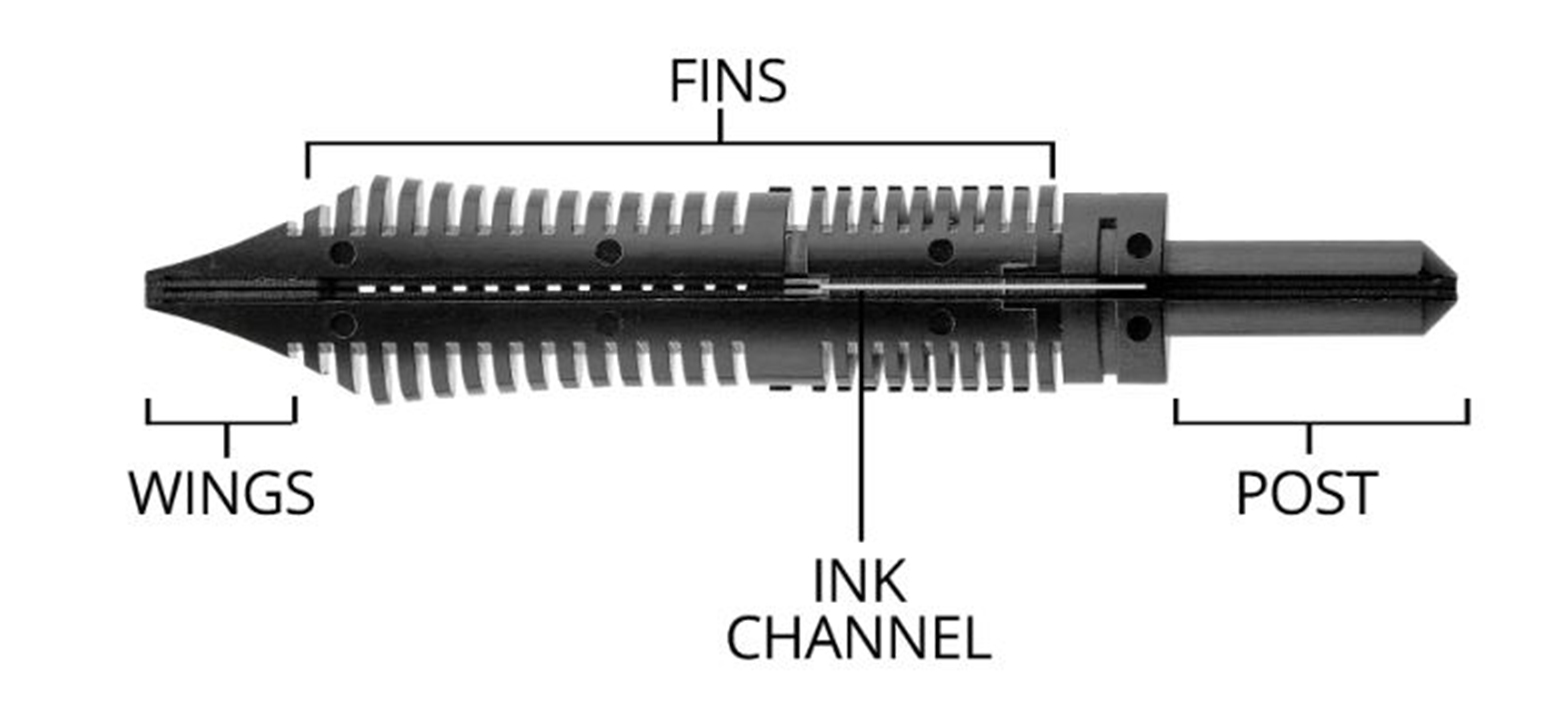
Feed: the piece of plastic or ebonite (usually black) that hugs the back of the nib and acts as a vehicle for ink delivery from the reservoir to the nib. Wings: the widest part of the feed that matches up to the nib shoulder. Sometimes nibs will slide on and grab onto the feed wings. Fins: the small, thin pieces on the feed that allow ink to saturate into the air channels. These act as an ink regulator for consistent flow when writing speed varies. Ink Channel: a very thin slit in the feed that hugs against the back of the nib and provides a route for the ink to travel through the feed. This is what helps to provide the necessary capillary action required for ink flow. Post: the back end of a feed that goes into the ink reservoir and feeds ink into the channel.
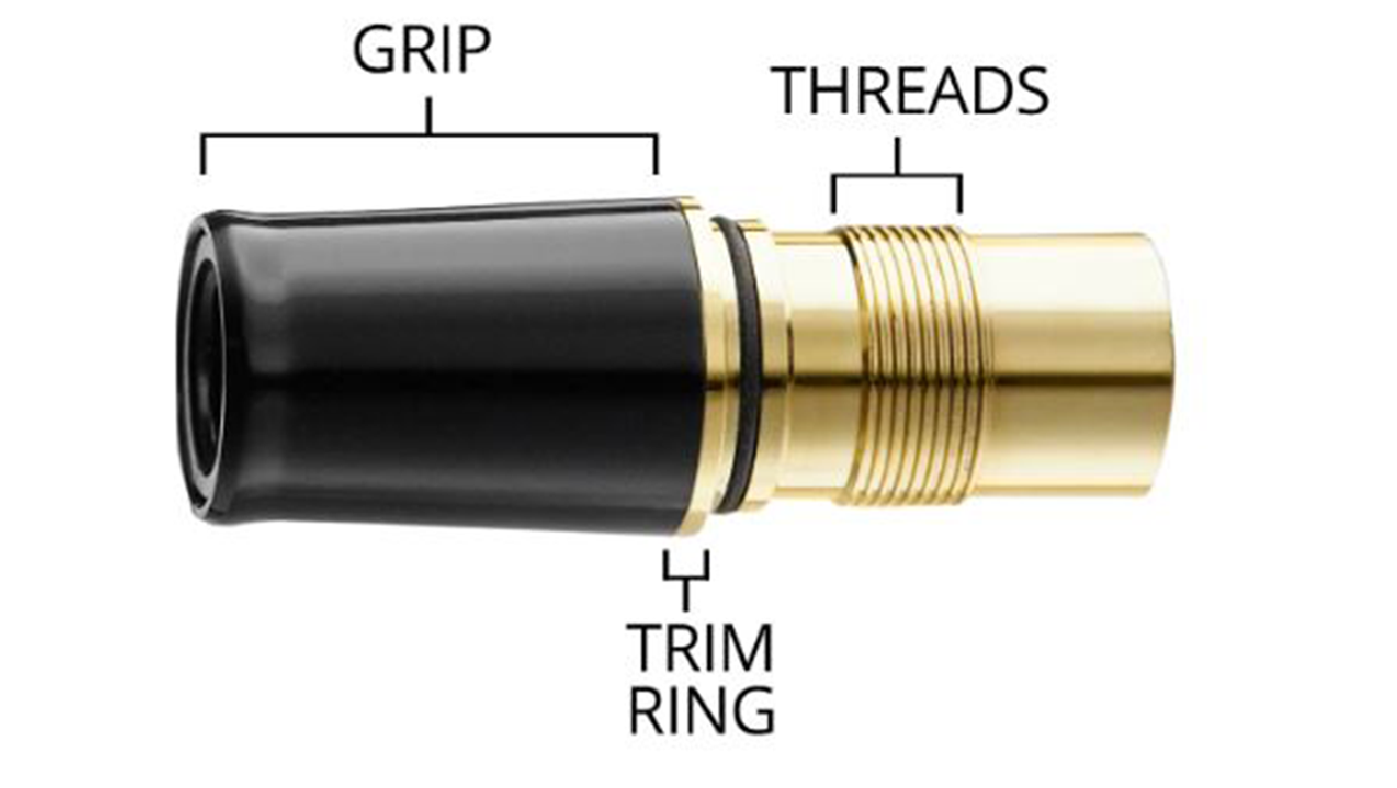
Section: the part of the pen where the nib fits in and attaches to the pen barrel. Grip: the front of the section where you hold where the nib fits in, sometimes called just a 'section'. Trim Ring: ornamental accents that serve an aesthetic purpose. Threads: thin grooves cut into a pen to hold parts together.
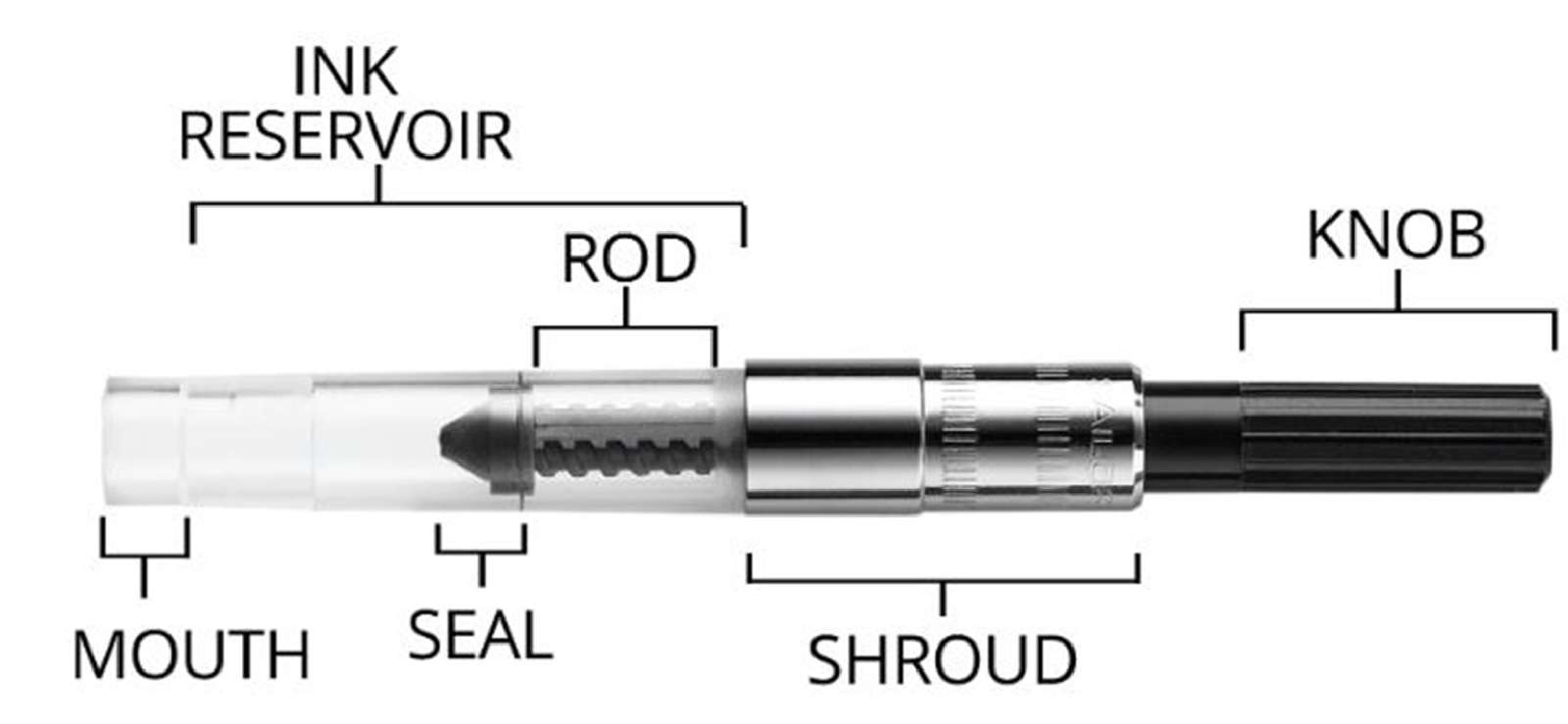
Converter: a small filling mechanism (usually a screw-piston type) that fits onto a pen that also accepts a cartridge. This allows you to use any brand's bottled ink instead of relying on limited proprietary ink cartridges. Mouth: the opening that fits onto the feed post to hold the converter in place. Ink Reservoir: a cavity inside a pen that holds ink. Seal: the 'working' part of the converter piston that creates a vacuum in order to draw ink into the reservoir. Rod: the threaded portion of the piston mechanism that causes the seal to move up and down when the knob is turned. Shroud: the metal covering that holds the piston mechanism onto the back of the ink reservoir. Knob: the part of the converter that you turn to move the piston seal up and down (and thus fill the converter).